By Alina Scerri
Over the years, one question has stayed with me. Not because a client asked it. But because, after more than a decade in investment migration, I found myself asking it.
What separates the families who simply accumulate wealth from those who preserve it for generations?
At first, I thought the answer was money. After all, the people I meet have often built remarkable businesses, managed international investments, or led companies that span several countries. But over time, I realised that wealth isn’t what makes them different. It’s the way they make decisions.
Most people plan around the next holiday, the next school year, the next investment, the next election. The families who build lasting legacies think differently. They’re already considering where their children might build careers ten or twenty years from now. They’re thinking about where future generations may want to live, study, invest, or raise their own families. Their decisions aren’t driven by urgency. They’re driven by perspective.
One conversation from several years ago still comes to mind. A client was reviewing different residency options, and naturally we discussed processing times, investment requirements, and legal frameworks. Then he paused and asked a question I hadn’t expected.
“If my grandson is born ten years from now, will he benefit from the decision I’m making today?”
It was one of the simplest questions I’d ever been asked, and one of the most profound. At that moment, the conversation stopped being about immigration. It became a conversation about legacy. That shift—from immigration to legacy—is something I encounter more often than people might imagine.
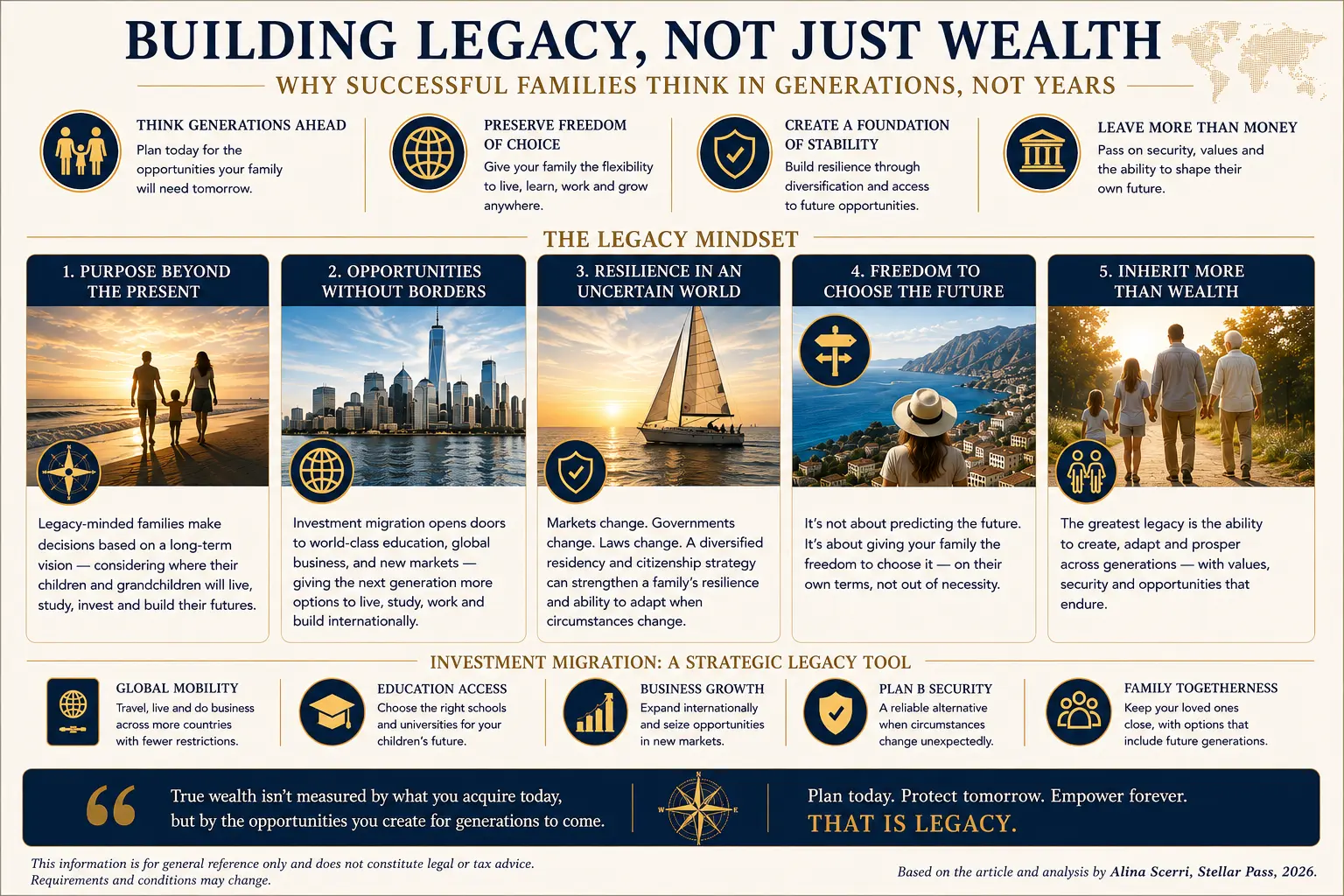
Contrary to popular belief, most successful families aren’t preoccupied with accumulating more wealth. They’re focused on creating stability and preserving freedom of choice. They know that markets fluctuate. Governments change. Tax systems evolve. Political priorities shift. They cannot give the next generation certainty—because certainty doesn’t exist. What they can give them is choice: the freedom to study where opportunity takes them, the ability to expand a family business into new markets, the flexibility to relocate if circumstances ever demand it, and the freedom to shape their own future without unnecessary limitations.
I’ve also noticed something else over the years. The clients who think this way rarely make rushed decisions. They’re willing to spend months asking questions, challenging assumptions, and analysing every possible outcome. Not because they’re indecisive, but because they understand that a well-considered decision made today can shape a family’s life for decades.
Sometimes people assume that investment migration is simply about obtaining a second passport or a residence permit. In my experience, that’s rarely the real objective. A passport or residence permit is ultimately just a legal document. What families are really building is resilience. They’re creating a structure that allows future generations to adapt to a changing world without having to start from scratch.
Perhaps that’s why some of the conversations I value most have very little to do with immigration law. We end up talking about education, family businesses, values, responsibility, and the kind of opportunities parents hope to create for children who are still too young to understand why such important decisions are being made today.
Those conversations remind me that investment migration has never been just about mobility. It’s about stewardship: recognising that success isn’t measured only by the wealth we leave behind, but by the opportunities we create for those who come after us.
Looking back on more than a decade in this field, I’ve realised that the families who leave the greatest legacy aren’t necessarily those with the largest fortunes. They’re the ones who understand that every important decision can have consequences far beyond their own lifetime.
Real wealth isn’t measured by what you can afford today. It’s measured by the choices your family will still have tomorrow.
FAQ
What does it mean for a family to think in generations rather than years?
It means making decisions based on perspective rather than urgency. Instead of planning around the next holiday, school year, or election, these families consider where future generations may want to live, study, invest, or build careers ten or twenty years from now.
Is investment migration only about obtaining a second passport or residence permit?
Rarely. A passport or residence permit is ultimately just a legal document. What families are really building is resilience—a structure that allows future generations to adapt to a changing world without having to start from scratch.
Why do successful families take so long to make residency or citizenship decisions?
Not because they are indecisive, but because they understand that a well-considered decision made today can shape a family’s life for decades. They are willing to spend months asking questions, challenging assumptions, and analysing every possible outcome.
How does a second citizenship or residency support a family’s legacy?
It preserves freedom of choice. Families cannot give the next generation certainty, but they can give them options: the freedom to study where opportunity takes them, to expand a business into new markets, and to shape their own future without unnecessary limitations.