By Alina Scerri
The global architecture of investment migration has reached a structural inflection point in August 2026. Driven by international security mandates, the historic “hands-off” economic citizenship model has permanently dissolved. Under the supervision of regional bodies like the Eastern Caribbean Citizenship by Investment Regulatory Authority (ECCIRA) and domestic legislative overhauls—such as St. Kitts & Nevis launching mandatory biometric passport enrollment—the Caribbean has shifted toward verifiable physical anchors. Simultaneously, agile oceanian and African entrants like Nauru and São Tomé & Príncipe have emerged, capturing high-velocity liquid capital with streamlined, tech-enabled alternatives.
For high-net-worth individuals (HNWIs) and family offices, evaluating cross-border asset insurance now requires balancing the Caribbean’s new biometric and physical presence requirements against these low-friction frontier pathways.
What is the 2026 Caribbean Biometric and Frontier CBI Mandate?
The 2026 Caribbean Biometric and Frontier CBI Mandate refers to new global regulations requiring mandatory in-person biometric enrollment (fingerprints, facial scans, and digital signatures), centralized due diligence registries, and physical presence verification. Established across the Caribbean under ECCIRA and St. Kitts’ 2026 reforms, these rules eliminate non-biometric passport renewals and set a strict $200,000 regional pricing baseline.
The Caribbean Biometric Shift: St. Kitts & Nevis Leads the 2026 Reform
For decades, Caribbean citizenship-by-investment (CBI) programs were favored by global investors for their friction-free processing. However, following the April 2026 launch of St. Kitts & Nevis’s mandatory biometric system, the federation became the first Caribbean nation to fully phase out standard non-biometric travel documents.
Key Operational Mandates for St. Kitts & Nevis
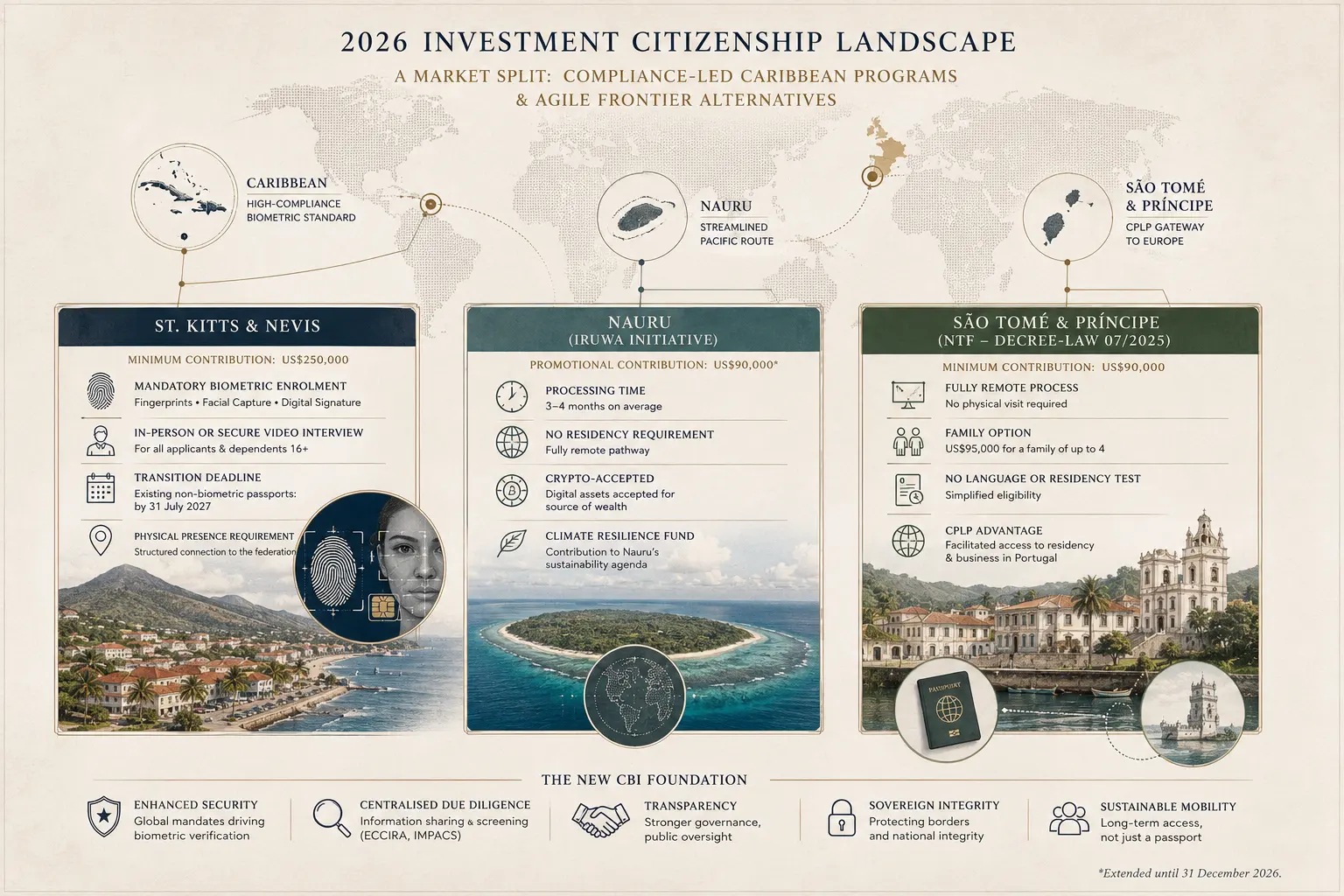
- Biometric Passport Standard: Effective April 14, 2026, all new applicants must complete biometric data collection (live facial capture, ten-print fingerprinting, and digital signature) at the Approval in Principle stage. All new travel documents issued are fully ICAO-compliant biometric passports.
- Transition Window for Existing Citizens: Existing citizens holding non-biometric passports issued prior to April 14, 2026, have been granted a strict transition period ending July 31, 2027, to complete biometric enrollment at authorized consulates or international collection hubs. Old passports will be invalidated for international travel after that date.
- Mandatory Vetting Interviews: Mandatory interviews—conducted in person or via encrypted video link—are now statutorily required for all primary applicants and dependents aged 16 and older.
- Physical Presence Verification: Applicants must demonstrate a structured physical connection to the federation, shifting the country away from pure donation-centric models toward long-term local integration.
Frontier Competitors: Nauru and São Tomé Capture High-Velocity Capital
As the Caribbean consolidates its security framework behind $200,000+ baselines, two new sovereign entrants are competing aggressively on pricing efficiency and processing velocity.
1. Nauru’s ECRCP: The $90,000 Iruwa Initiative Extension
In the Pacific, the Nauru Economic and Climate Resilience Citizenship Program (ECRCP) has officially extended its promotional Iruwa Initiative until December 31, 2026. Under this limited-time offer, single applicants contribute $90,000 to Nauru’s climate resilience fund—representing a $25,000 reduction from the statutory $115,000 base fee.
With processing timelines averaging 3 to 4 months, zero physical residence requirements, and institutional acceptance of digital asset liquidity for source-of-funds verification, Nauru has become a primary hedge for technology founders and digital asset managers.
2. São Tomé & Príncipe: The $90,000 CPLP Gateway
In West Africa, São Tomé and Príncipe established its National Transformation Fund (NTF) under Decree-Law 07/2025. Priced at a flat $90,000 for a single applicant and $95,000 for a family of up to four, it is currently the world’s most cost-effective family citizenship program.
While processing takes 2 to 3 months with no visit requirements, São Tomé’s strategic value lies in its membership in the Community of Portuguese Language Countries (CPLP). Under CPLP accords, São Tomé citizens enjoy simplified legal residency and business registration pathways in Portugal, establishing a lower-cost long-term bridge into the European Union over a 7-year timeline.
“The market has split. Investors seeking top-tier international acceptance and visa-free stability are committing to the $200,000+ Caribbean biometric standard. Meanwhile, those needing immediate liquidity protection or a low-cost CPLP bridge are moving toward Nauru and São Tomé.” — Marcus Vance, Senior Global Migration Analyst
FAQ
What is the deadline for existing St. Kitts passport holders to obtain a biometric passport?
Existing St. Kitts & Nevis citizens who hold non-biometric passports issued prior to April 14, 2026, have until July 31, 2027, to complete biometric enrollment at designated consular centers or international collection hubs. Old passports will not be valid for travel after this date.
How long is Nauru’s $90,000 Iruwa Initiative promotional pricing valid?
The Government of Nauru officially extended the discounted $90,000 contribution rate for principal applicants under the Iruwa Initiative until December 31, 2026. On January 1, 2027, the baseline contribution reverts to $115,000.
Does São Tomé citizenship require physical residency or a language test?
No. The São Tomé and Príncipe Citizenship by Investment Program under Decree-Law 07/2025 is fully remote. There are no language requirements, no physical residency mandates, and no requirement to visit the country before or after citizenship is granted.
Technical Sources & Regulatory Citations:
- Citizenship by Investment Unit (CIU) St. Kitts & Nevis: Official Guidance Notice on Biometric Passport Modernisation and Enrolment Timelines (April 2026).
- Nauru Program Office: Executive Order on the Extension of the Iruwa Initiative Contribution Schedule (July 2026).
- Government Gazette of São Tomé and Príncipe: Decree-Law 07/2025 – Establishment of the National Transformation Fund.
- Eastern Caribbean Central Bank (ECCB): ECCIRA Regional Regulatory Compliance and CARICOM IMPACS Data Sharing Report (2026).